Rattling Antlers for Mule Deer: What Works, What Doesn't, and Why It's Different Than Whitetail
Mule deer respond to rattling, but not the way whitetail do. Timing, terrain, sequence length, and realistic expectations all shift when you're hunting open country bucks in October and November.
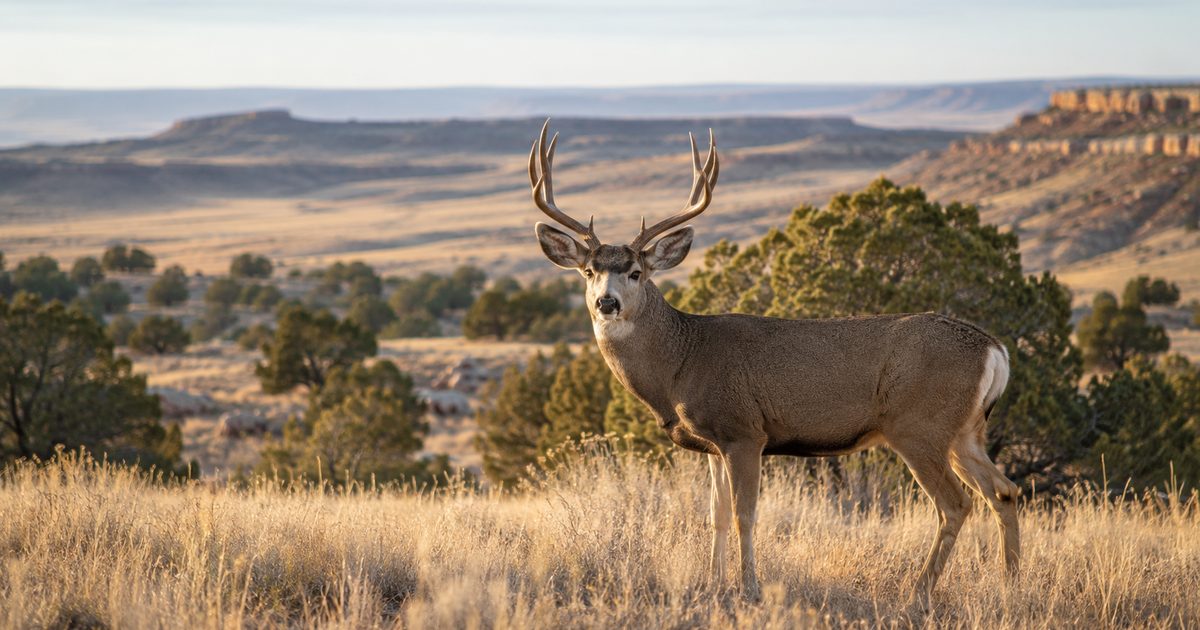
Rattling works on mule deer. That’s the honest starting point — not “it doesn’t work out west” and not “it works just like it does on whitetail.” The truth sits somewhere between those two positions, and understanding the specific conditions where mule deer will respond to rattling is what separates hunters who occasionally pull it off from those who write it off after one frustrating morning.
Mule deer are not whitetail in a different landscape. Their social structure, their terrain, and their rut behavior are different enough that whitetail rattling sequences transposed directly to a western mule deer hunt often fail not because rattling doesn’t work, but because the technique doesn’t match the animal.
Why Mule Deer Respond Differently
Whitetail bucks respond aggressively to rattling because they defend defined home ranges against other bucks. Mature whitetails are territorial — a buck’s core area is worth fighting for, and the sound of two bucks fighting represents a direct threat to his breeding access. He charges in to assert dominance or run off the competition.
Mule deer operate on larger ranges with lower buck densities per square mile in most western habitats. They’re less territorial in the strict whitetail sense. A mule deer buck that hears rattling is more likely responding to curiosity about a breeding opportunity — the sound of fighting bucks could mean a doe is nearby — than to defend a specific patch of ground. That distinction matters because it changes how you set up, how long you rattle, and what you do when a buck appears.
Mule deer also tend to hang up at distance more often than whitetail. They’ll stop 200 or 300 yards out, stand broadside, and study the situation. This isn’t a failure of the calling — it’s mule deer behavior. They assess before committing. Knowing that ahead of time prevents you from over-calling or making a desperation move when a buck pauses.
When to Rattle: The October–November Window
The mule deer rut runs later than most hunters expect. Peak breeding typically occurs in late November across most of the West, with the pre-rut phase — when rattling is most effective — running from mid-October through the first weeks of November depending on latitude and elevation.
During the pre-rut, bucks are actively seeking does and competing with other bucks. Testosterone is high enough to make a buck respond to aggressive sounds, but breeding competition hasn’t peaked to the point where he’s locked onto a doe and ignoring everything else. This window — roughly October 20 through November 10 for most western states — is your best opportunity.
The rut peak in late November can also produce responses, but it’s less reliable. A buck that’s already found a hot doe isn’t leaving her to investigate a fight. You’re competing with a real incentive. The pre-rut phase is where bucks are still mobile, still searching, and still willing to investigate.
Watch Bucks Before You Call
Spend time glassing before you commit to rattling in a new area. If you’re seeing bucks that are still in bachelor groups and not yet chasing, the pre-rut hasn’t started. Save your rattling energy for when you’re watching bucks actively pursuing does or fighting. Calling into an area that hasn’t hit the right phase wastes the opportunity and potentially educates deer you’ll want to hunt later.
The Sequence: Aggressive vs. Subtle
The most effective rattling sequence for mule deer is shorter and less aggressive than what most whitetail hunters are accustomed to. A two-to-three minute sequence that starts with light ticking and builds to moderate engagement — not the extended, crashing sequences that whitetail hunters sometimes use — is the starting point.
Begin with 20 to 30 seconds of light antler contact. Gentle clicking and grinding that sounds like two bucks sparring casually, not fighting for their lives. Give it four to five minutes of silence. If nothing responds, run a second sequence that’s more aggressive — 60 to 90 seconds of harder contact with some grinding and twisting. Then wait again.
Don’t rattle in short, frantic bursts and immediately go silent for 20 minutes. Mule deer in open country can see a long way, and if they approach cautiously from a distance, they’re watching the spot where the sound came from. If everything goes dead silent, many bucks will turn around. Keep subtle tickling sequences going during your wait periods to hold an approaching buck’s attention.
The biggest mistake is over-rattling. A continuous aggressive sequence that goes on for five minutes sounds like nothing in nature. Mule deer that have heard rattling and didn’t like what they saw — or sensed something wrong — don’t come back for a second look that day.
Silence Kills the Approach
Don’t rattle hard and then go completely silent for 20 minutes. A buck working toward you from 400 yards needs to keep hearing something to stay committed. Light, intermittent contact every few minutes during your wait keeps him oriented. Going fully silent after your main sequence often causes distant bucks to swing wide or turn back.
Real Antlers vs. Synthetic Rattling Bags
Real shed antlers produce a more authentic sound than rattling bags or compact synthetic alternatives. The mass, texture, and resonance of actual bone create a tonal range that synthetic materials approximate but don’t replicate exactly. For mule deer in open country — where sound is a primary cue and bucks can hear from a significant distance — real antlers are worth carrying.
The downside is weight and bulk. A matched pair of medium-sized sheds adds real weight to a pack already loaded with gear for a multi-day backcountry hunt. If pack weight is the constraint, a quality compact rattling system — the Flextone Battle Bag and Knight & Hale EZ Grunter Plus are both used by western hunters — is better than leaving antlers behind entirely.
One practical middle ground: carry a single medium-sized shed or a set of compact real antlers. The sound quality is meaningfully better than a bag, and half the weight of a full matched set. You can produce a convincing sequence with one antler and your leg or boot to create resistance — it sounds unusual in writing, but works in the field.
How Terrain Shapes Sound Carry
Open country and canyon systems behave very differently as acoustic environments. On a flat sage flat or a gentle bench, rattling sound travels predictably in all directions. You can expect deer in a wide radius to hear you. The problem is that you can also expect them to see you — set up against a feature that breaks your silhouette (a ridge shoulder, a juniper, a rock face) and position yourself to watch the approach.
Canyon systems concentrate and direct sound in ways that open terrain doesn’t. Sound carries down canyon corridors and around bends in ways you can’t fully predict. A buck 600 yards away in the right drainage may hear you clearly; a buck 300 yards away on the wrong side of a ridge won’t hear anything. Scout for topography that funnels sound into areas where you’re seeing deer. Setting up on a point above a canyon junction gives you sound projection into multiple drainages simultaneously.
Wind direction in canyon country is also more variable than on flat terrain. Thermals shift with sun exposure and time of day. A setup that has the wind in your favor at 7:00 AM may be pushing your scent right into the area you’re rattling into by 10:00 AM. Check your thermals throughout the session, not just at setup.
Wind, Approach, and Setup Position
Wind management on mule deer rattling setups is identical to any other calling situation — your scent cone can’t blow into the area you expect the deer to approach from. That sounds obvious, but in open country it’s more complicated than it seems. Mule deer can appear from any direction, and the buck that circles downwind before committing is the most common scenario for busted hunts.
Set up with the wind in your face or at a quartering angle to the most likely approach. Position yourself with at least 200 yards of open ground or visible terrain behind you so that any deer circling wide to get downwind has to cross open ground you can see and respond to. Don’t set up with your back to a cliff or dense brush that funnels deer directly downwind without you seeing them.
Set Up for the Circle
Mule deer that respond to rattling often circle to get downwind before committing to the final approach. Position yourself so that circle is visible — ideally over a ridge or around an open shoulder where you’ll see the buck before he winds you. The circle isn’t a failed response; it’s a confirmation that the calling worked. Be ready to shoot through the circle, not just at a straight-line approach.
Combining Rattling with Calling
Grunt calls and snort-wheeze vocalizations used alongside rattling increase the realism of your setup. The grunting of bucks during a fight is a natural accompaniment to antler contact, and mule deer grunts are lower and slower than whitetail grunts — a long, drawn-out single note rather than the staccato tending grunt most whitetail hunters use.
The snort-wheeze is an aggressive dominance vocalization that mature bucks produce when challenging another buck. It’s a high-percentage call on a buck that’s already in a dominant, aggressive mindset during the pre-rut. Use it sparingly and only when you see a buck that’s working toward you — don’t open with a snort-wheeze cold, because a less dominant buck will turn and leave rather than engage.
Start every rattling sequence with antlers, add intermittent grunts, and hold the snort-wheeze in reserve for bucks within 100 yards that are hanging up.
When a Buck Appears: Close vs. Distant
How you handle the moment of contact depends on how far away the buck is. A buck that steps out at 60 yards and is walking toward you — don’t move, don’t call again immediately, and don’t reach for your rangefinder unless it’s already in your hand. You’re past the calling phase. Hold still, wait for him to close or stop in a shooting lane, and take your shot.
A buck that hangs at 250 yards and won’t commit is a different situation. Light rattling or a low grunt can pull him in closer, but it’s more likely he’s waiting for visual confirmation of the fight. If you have enough cover, try moving your antlers above the brush line so he can see them — the visual cue can be enough to break his hesitation. If he doesn’t commit after 10 to 15 minutes of patient calling, he’s probably not coming in. Let him go, reposition to a different drainage, and try him later in the day when the wind shifts.
Honest Expectations for Western Mule Deer
Rattling for mule deer has a lower success rate than rattling for whitetail. That’s not pessimism — it’s the reality of hunting lower-density populations across larger terrain in open country where deer can evaluate the situation from a safe distance before committing.
In good mule deer country during the pre-rut, rattling will draw in a buck or produce a visible response roughly 15 to 30 percent of the time you try it — meaning visible interest from a deer, not a tag-punching encounter. Actual shot opportunities from rattling are less common. Hunters who use rattling as one tool among several — combined with glassing, stalking, and patience — fill more tags than those who treat calling as a primary strategy.
Start With Good Buck Sightings
Don’t commit to a long rattling session without first confirming you’re in country that holds bucks. Rattle where you’ve seen deer, specifically where you’ve seen bucks. Calling into empty terrain is a time cost you can’t recover. Use your binoculars to locate deer first, then position yourself within range of where those deer are living and use rattling to close the final gap.
The technique works. It’s not magic, and it’s not wasted effort — it’s a real tool that produces shot opportunities that pure glassing and spot-and-stalk can’t replicate. Mule deer that wouldn’t have moved in daylight have committed to rattling during the pre-rut. The key is timing it right, keeping sequences shorter than you’re instinctively inclined to, and being set up to handle a buck that arrives cautiously from any direction.
Get those pieces right and you’ll give yourself chances that most western hunters never take.
Next Step
Check Draw Odds for Your State
Tag-level draw odds across 9 western states — filter by species, unit, weapon, and points. Free to use.
Get the Insider Edge
Join hunters getting exclusive draw odds data, gear deals, and weekly hunt planning tips.
Related Articles

Arizona Elk Calling: September Archery
September archery elk in Arizona means calling. Here's the practical guide to bugles, cow calls, and the timing that produces bulls.
Arizona Hound Hunting Regulations Guide
Arizona hound hunting for bear and lion requires specific permits and tags. Here's the complete regulatory guide for 2026.

Arizona Shed Hunting: Rules & Season Guide
Arizona has specific rules on shed antler collecting. Here's the complete guide to the season, the ethics, and the most productive areas.
No comments yet. Be the first to share your experience!