High-Country Mule Deer Late Season: When the Migration Puts Big Bucks in the Open
Late-season mule deer hunting tactics for mountain states. Migration timing, transition zone ambush, snow as a tool, field reading mature bucks moving from high summer range to winter ground — and how to be in position when it happens.
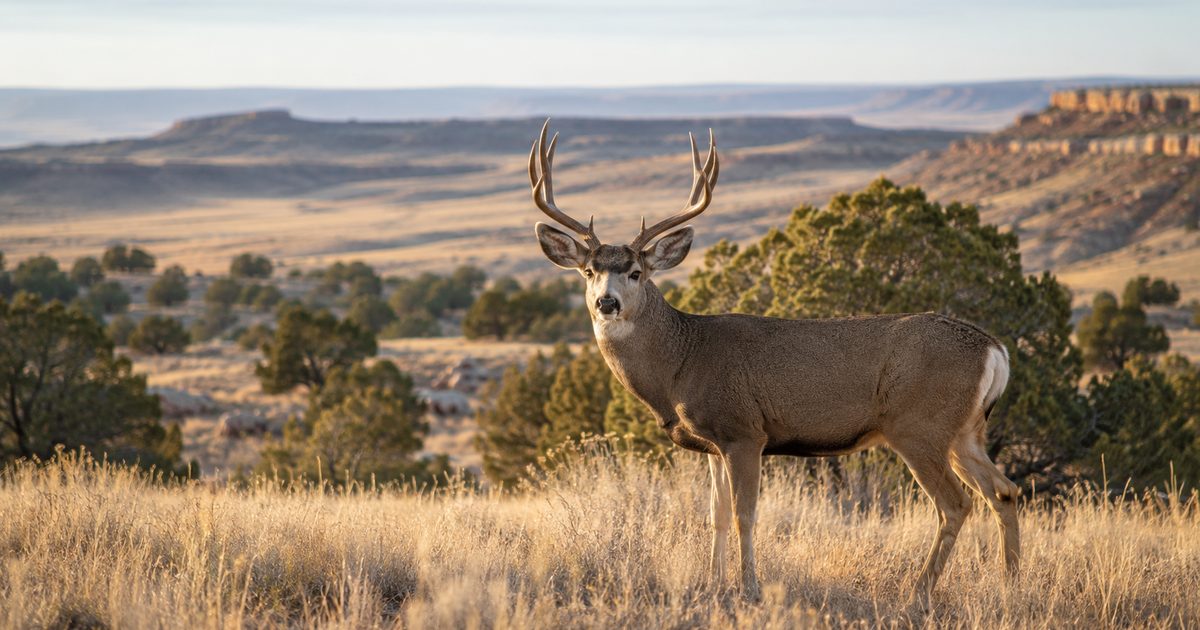
The window when mature mule deer bucks are visible in open terrain, moving predictably, and actually findable is narrower than most hunters expect. It’s not archery season in July when they’re summering above 11,000 feet with no hunting pressure. It’s not mid-October when they’re scattered across transition zones without a pattern. It’s the two-to-four-week window in late October and November when snow on the high range pushes them down to winter habitat and the rut pulls them out of cover during daylight hours. Miss that window and the big bucks disappear again until next year.
This is the hunt that produces the bucks you see in photos. The mature 4x4s and 5x5s with dark antlers and swollen necks. They earned those antlers by surviving every hunter who tried to find them during archery season in the high basins, every mid-October rifle opener with 200 trucks at the trailhead, every pressure event that pushed them deeper into timber. By November, the same combination of biological and meteorological forces that kept them invisible brings them out into the open for anyone positioned and ready.
The question isn’t whether the bucks will move. They will. The question is whether you’ll be in position when they do.
Understanding the Migration
Mule deer follow elevation-driven migration routes that haven’t changed in generations. The same ridgelines, drainage crossings, and saddles that deer used before significant hunting pressure existed are still the routes they use today. In states with serious migration research — Wyoming, Colorado, Idaho — biologists have documented corridors that are startlingly consistent year to year and animal to animal. Individual bucks tracked via GPS collars follow routes that their mothers and grandmothers used. The route is effectively hard-coded.
What triggers the movement is snow on the summer range. The first significant storm that drops 12 inches or more on the high basins at 10,500-12,000 feet starts the evacuation. Deer don’t wait for the snow to consolidate or the storm to pass — they move within 24-72 hours of the storm hitting the high country. They’ve been doing it long enough that the behavior is practically reflexive. Snow arrives, the herd moves.
This is what makes late-season mule deer hunting so different from other big game hunting. You’re not reading fresh sign and adapting in real time. You’re reading weather and terrain. The bucks are going to show up in specific places on a predictable timeline. Your job is to be there first.
Migration corridor research is available for some states through wildlife agency publications and university studies — Wyoming’s migration initiative has produced some of the most detailed public corridor maps available anywhere in the West. Dig into that data for the unit you’re hunting. It changes how you read the terrain.
The Storm Trigger
This is the most important variable in late-season mule deer hunting, and it’s the one most hunters don’t track closely enough.
Watch the high-elevation weather forecast in the weeks leading into your hunt. Not the forecast for the valley where you’re camping — the forecast for the top of the summer range. In Colorado, that means keeping an eye on 11,000-12,000 feet in the unit. In Wyoming, the high basins above 9,500-10,000 feet. Weather.gov provides point forecasts for specific coordinates and elevations; plug in the GPS coordinates of the high basins you’ve been scouting on the topo and get a forecast specific to that elevation band.
The 24-72 Hour Movement Window
When a storm drops 12 or more inches on the high summer range above 10,500 feet, mule deer start moving within 24-72 hours — sometimes faster in hard early-season storms. Pre-position in the transition zone before the storm breaks, not after. By the time the weather clears and the roads open up, the first wave of deer has already moved through. If you’re scrambling to get to the unit after the storm, you’re already behind.
The practical implication is that you need flexibility in your schedule. Hunters who book fixed vacation days and show up regardless of whether the storm has hit are gambling on timing they don’t control. If you can plan your hunt around the weather pattern rather than fixed calendar dates, you can catch the movement at peak intensity instead of arriving to country that already evacuated.
The Rut Overlap
In most mountain states, peak mule deer rut falls in early-to-mid November — which is the same window as the migration. This is the most important timing variable in late-season mule deer hunting. The two forces reinforce each other.
Bucks chasing does in the transition zone during early November are in daylight more than at any other time of year. Big bucks that spent September and October invisible in dark timber emerge onto the sage benches and south-facing slopes where does concentrate in early winter. A mature buck that you couldn’t find on an aerial photograph in October will be in the open at 10am in early November because a doe is feeding on a bench a mile below his summer range and he won’t let her out of his sight.
The Rut-Migration Double Window
The overlap of the migration and the rut in early-to-mid November creates the best mule deer hunting of the year. Bucks are moving on a biological timer, responding to does that are bunching up in the transition zone. A buck that survived two months of archery season and the early rifle opener by staying in thick timber will walk across an open hillside in broad daylight during this window. Plan your late-season hunt to hit the November 5-20 period if the season structure allows it.
The rut also extends the window when bucks are predictable. Outside of the rut, a buck’s daily pattern is driven by feeding and security cover. During the rut, the does drive the pattern and the bucks follow. Find the does on the feeding benches and the bucks won’t be far.
Transition Zone Terrain
The productive late-season hunting ground is the band between the evacuated high country and the established winter range. It’s not the tops of the mountains — those are empty by late October after the first hard storm. It’s not the valley floors or the low sagebrush country where deer overwinter — that’s where they end up, but they stack in the transition before committing to it.
The transition band typically runs from 7,500 to 9,500 feet and looks like: sage benches on south-facing aspects with dried grass and browse, aspen pockets on mid-slope benches, rocky ledge systems on sun-exposed ridges, and mixed timber where conifer transitions to sage and open country. This terrain holds food (residual dried forbs and browse that south exposures protect from early snow), security (the aspen pockets and rocky ledges), and thermal regulation (south-facing slopes catch sun even in November, which is why deer concentrate there when high country is cold).
Deer stack here before committing to lower winter habitat. The pressure from hunters pushing them out of the high country pushes them down; the food and cover in the transition zone stops the movement temporarily. That’s the window.
Glassing Strategy
Morning glassing means being in position with glass on south-facing slopes at 8,000-9,000 feet before first light. Not walking to your glassing point at first light — already there, settled, glass deployed. Bucks are most active in the first 90 minutes of daylight, and they’ll be on the lower benches feeding before they move uphill to bed.
The daily pattern is readable once you understand the terrain. Bucks feed on sage benches and open hillsides in the early morning hours, then move upslope to bed in the upper edge of aspen timber or on rocky ledge systems at mid-elevation. They’re not in the deepest dark timber mid-day — they’re on the sunny ledges where they can see and feel warmth. In the afternoon, they reverse the pattern: move down from beds to feed as light drops.
Glass the feeding areas in morning transition light. Use the middle of the day to locate bedded animals by scanning ledge systems and the edge of timber above the feeding zone. Plan your afternoon stalk based on where the buck beds — the approach can be made from above in most terrain, keeping you above the thermal convection that carries scent up-slope in the afternoon.
Glassing Position Setup for South Aspects
Set up your glassing position on the north-facing slope across the drainage from the south-facing slopes you’re glassing. You’ll be in shade, which reduces your silhouette and keeps you out of the thermals rising from the sunlit slope opposite you. Distance should be 400-800 yards — close enough to identify individual animals with a spotting scope at 20-40x, far enough that you’re not in shooting range of deer you haven’t yet evaluated. A quality tripod-mounted spotting scope matters more here than anywhere else in hunting.
Don’t rush the glassing. An hour of methodical grid-scanning a single south-facing slope will reveal deer that a casual 15-minute look misses. Bucks at rest blend into terrain exceptionally well — you’re looking for the horizontal line of a back, the flicker of an ear, the flash of antler when a buck turns his head. Patience at the glass is how you kill late-season mule deer without burning a single calorie on approach until you’ve already identified the animal and planned the route.
Snow as a Tool
Fresh snow is one of the most useful pieces of information a late-season hunter can have. A saddle crossing with a set of large, fresh tracks tells you exactly where animals moved in the last 12-24 hours. Tracks in new snow that fall outside the normal size range of does — a mature buck’s hoof spread and stride are both measurably larger, and the depth of the track in soft snow tells you about the animal’s mass — give you a starting point for understanding which animals are using the route.
Following fresh tracks in new snow is one of the most effective late-season tactics for any deer species. It works. You’re moving on confirmed intelligence rather than probability. The tracks tell you the animal’s direction of travel, speed (spacing between prints), whether it stopped and fed (turned tracks, disrupted snow surface), and roughly how long ago it passed (track edge sharpness and wind erosion).
Snow also slows deer movement in a way that benefits the hunter. Animals don’t blow out of terrain in deep snow the same way they do on bare ground. A mule deer in 18 inches of snow on a steep hillside moves deliberately. It doesn’t make a 400-yard run and look back from the next ridge — it walks, pauses, and picks its route. That gives a stalking hunter real opportunity to close distance without triggering a full-speed exit.
Cold-Weather Hunting Logistics
Late-season mountain hunting in November means cold. Single-digit temperatures at camp overnight, wind on any exposed terrain, and the real possibility of a storm that drops another foot of snow and keeps you in camp for a day. Base-layer weight matters more than outer-shell weight in these conditions — a good merino wool or synthetic base layer next to your skin, a midlayer fleece or puffy, and a windproof shell handles everything down to about 5°F when you’re moving.
The problem is when you stop moving. Four hours on a glassing position at 8,500 feet in 15°F air with a 10-mph wind is radically different from hiking to that position. Bring insulated pants to put on when you sit down to glass. Bring hand warmers — HotHands packets weigh nothing and they’re the difference between functional trigger-finger control and numb hands when you need them most.
Cold-Weather System for Late-Season Glassing
For stationary glassing in November mountain conditions: heavyweight merino base layer top and bottom, insulated bib overalls to put on when you stop, a 700-fill down jacket or synthetic puffy as a midlayer, windproof softshell or hardshell over that. Insulated gloves that can be pulled off quickly for a shooting grip — liner gloves underneath let you do that without exposing bare skin. Chemical heat packets for hands and toes. Don’t dress for hiking; dress for four hours of sitting still at temperature.
Boots with serious insulation — Pac boots or insulated leather mountain boots — matter more in late season than in early season. Wet feet from post-holing through crust snow, standing at a glassing point for hours, and temperature drops at altitude will destroy a hunter’s effectiveness and focus faster than any other comfort variable. Don’t let gear decisions cut the hunt short when the window is this narrow.
Wyoming and Colorado Late-Season Tags
Both Wyoming and Colorado offer late-season mule deer tags in certain units that draw at lower preference point requirements than the peak rut or early rifle season dates. In units where the migration timing aligns with November tag dates, those tags can produce exceptional bucks at draw thresholds that are 2-4 points below the premium early-rifle tags in the same unit.
The logic is straightforward: most hunters prefer early-season tags when the weather is predictable and the terrain is accessible. Late-season tags come with the risk of hunting in serious cold and potential road closures. That perceived risk keeps the draw competition lower. For hunters who are prepared for November mountain conditions — which isn’t complicated if you’ve done the gear work — the late-season tag in a high-quality unit is one of the best value propositions in western hunting.
Check the Draw Odds Engine and filter by season dates — sort the November and December designations by draw odds. The gap between early and late tags in the same unit is often more than hunters expect. You’re also looking for units with documented migration corridors, which narrows the list considerably and focuses the research.
Putting It Together
Late-season high-country mule deer hunting is a timing game more than anything else. The bucks are there. The routes are documented. The terrain tells you where they’ll be. What separates hunters who fill tags from hunters who see empty country is whether they’re in the right place during the two-to-four-week window when the migration and the rut overlap to put mature bucks in predictable terrain during daylight hours.
Watch the high-country weather. Pre-position in the transition zone before the storm breaks. Glass south aspects from across drainage in the morning. Let the snow tell you where animals moved overnight. Stay in position when it’s cold enough to want to leave. The big bucks that survived every earlier hunting pressure event are going to walk across an open hillside in November. Make sure you’re there when they do.
Next Step
Check Draw Odds for Your State
Tag-level draw odds across 9 western states — filter by species, unit, weapon, and points. Free to use.
Get the Insider Edge
Join hunters getting exclusive draw odds data, gear deals, and weekly hunt planning tips.
Related Articles

Arizona Elk Calling: September Archery
September archery elk in Arizona means calling. Here's the practical guide to bugles, cow calls, and the timing that produces bulls.
Arizona Hound Hunting Regulations Guide
Arizona hound hunting for bear and lion requires specific permits and tags. Here's the complete regulatory guide for 2026.

Arizona Shed Hunting: Rules & Season Guide
Arizona has specific rules on shed antler collecting. Here's the complete guide to the season, the ethics, and the most productive areas.
No comments yet. Be the first to share your experience!